
America’s Broken Health Establishment
President Donald Trump’s 2016 campaign galvanized the nation on the promise to restore American greatness. Yet that mission to Make America Great Again rests on a prior premise: that the nation has been in decline; that key institutions no longer deserve the respect and authority they once held; and that public officials have failed to uphold the people’s trust.
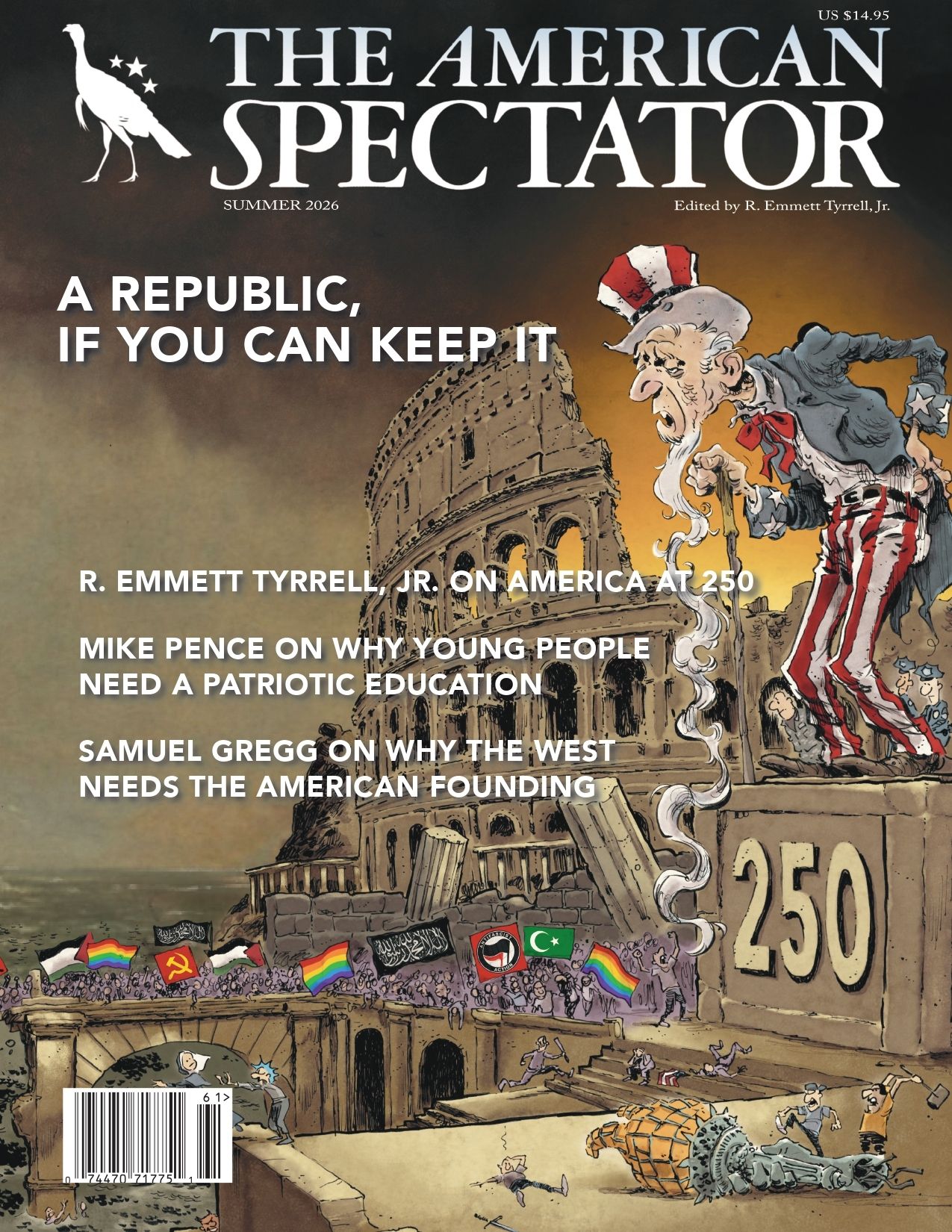
This article is from The American Spectator’s summer 2026 print magazine. Subscribe to The American Spectator to receive the magazine.
For all the successes of Trump’s first term, Trump’s own failure in 2020 to restrain Anthony Fauci and prevent sweeping COVID lockdowns revealed that yet another institution had squandered the public trust: our public health establishment.
Public health officials weaponized the public’s trust in the supposed expertise of medical professionals and brought the nation to its knees. They halted American social and civic life in the name of safetyism and imposed on the American people the unquestionable rituals of masking, social distancing, and the mRNA booster shot.
In the aftermath of 2020, many of Trump’s supporters realized that the COVID inquisition was only the glaring symptom of the systemic failure in the health, food, and medical industries. In the years since, America’s medical institutions have experienced a crisis of public trust. In April 2020, for example, over 70 percent of Americans said they trusted hospitals and doctors “a lot.” Today, that figure has fallen to just 40 percent.

Subscribe to The American Spectator to receive our summer 2026 print magazine.
Although medical professionals frequently try to castigate skepticism as misinformation or denying “the science,” that loss of trust is the natural result of the fact that the medical profession has undermined its own credibility.
For decades, America’s public health institutions have ignored and even facilitated the erosion of our national health. They stood idly by as the nation’s food supply became loaded with artificial additives and harmful chemicals, as people’s homes and water supplies became exposed to scores of toxic substances, and as the pharmaceutical industry ran amok and captured the very regulatory agencies designed to restrain it.
The nation’s current health and food system has enriched Big Pharma and Big Food while sacrificing the well-being of millions of Americans. Now, health care costs are the largest category of federal spending and represent roughly one-third of the federal budget. Yet despite trillions in health care spending, Americans are less healthy than ever before.
In light of this institutional decay, the MAHA movement is central to Trump’s mission of national renewal. If America is to experience a new golden age, Americans must once again become healthy and revitalized.
Uncovering ‘A Tremendous Amount of Corruption’
Since taking office last year, Robert F. Kennedy Jr. and his Department of Health and Human Services have begun to shed light on the extraordinary corruption within federal health care agencies.
One of Kennedy’s first acts as health secretary was to completely remove and replace the members of the CDC’s Advisory Committee for Immunization Practices. According to Kennedy, most of the committee’s former members had “received substantial funding from pharmaceutical companies” and “regularly participated in deliberations and advocated products in which they had a financial stake.” In one striking example, a former member made $186 million by selling his share in a patent for the vaccine he had voted to add to the childhood vaccine schedule.
Kennedy framed this overhaul as essential to restoring public trust — trust “broken because of issues with transparency and conflicts of interest within the committee.” Yet even this case, as obviously unacceptable as it is, hardly scratches the surface of a much deeper institutional decline.
According to Kennedy, the National Institutes of Health as a whole must be transformed. In a hearing last year, he stated, “When I was a kid, the NIH was the premier, gold-standard scientific institution in the world. Over the years, it was captured by industry … and there was a tremendous amount of corruption.”
When HHS proposed its 2026 fiscal budget, the agency assessed that “NIH has broken the trust of the American people.”
According to HHS, the department had been plagued with “wasteful spending, misleading information, risky research, and the promotion of … radical gender ideology to the detriment of America’s youth.” In response, the Trump administration took decisive action by cutting NIH funding by almost 40 percent.
Yet the delinquency of our public health agencies doesn’t stop there. As another example, Kennedy’s HHS has also uncovered a long-standing “systemic disregard for sanctity of life” among one of the nation’s major organ procurement organizations. The report found “clear negligence,” as hospitals allowed the organ procurement process to begin even though patients still showed signs of life.
Reports from HHS and the New York Times identified a systemic problem of “rushed or premature attempts to remove [people’s] organs.” According to these findings, pressure to harvest more organs has fostered “a pattern of rushed decision-making that has prioritized the need for more organs over the safety of potential donors.”
As a result, many patients who had been approved for organ harvesting were still showing unmistakable “signs of life,” such as “gasping” for air or “crying.” In one instance, an unconscious man started to wake up as doctors were about to remove him from life support to take out his organs. Despite this, officials tried to proceed even as the man was visibly distressed — crying, curled into a ball, and shaking his head.
Such misbehavior blatantly violates what ought to be the first rule of medical practice: do no harm.
Simply put, reports like this have demonstrated that the negligence of the health care industry extends even to those experts who have been entrusted with the most difficult and sacred responsibilities. For the millions of Americans registered as organ donors, they are placing their trust in the ethical character and wisdom of agencies whose track record has not proven they deserve it.
Underlying Challenges of Legitimacy
While Kennedy’s HHS has shed light on a number of concrete ways the public health sector has become corrupt, the illegitimacy of medical professionals has become deeply and systematically entrenched.
Fundamentally, the health industry has failed to address the root causes of chronic disease. Treating these conditions, along with mental health, now accounts for 90 percent of America’s annual $4.9 trillion in health care expenditures. Although modern medicine excels at acute intervention — trauma care, surgical precision, life-saving drugs — it struggles to confront the slow-moving crises that now dominate public health: obesity, diabetes, and cardiovascular disease.
Paradoxically, the most advanced medical system in history coexists with worsening population health metrics.
One of the most corrosive elements in modern health care is not a single drug, policy, or institution, but the revolving door that tightly links regulators, pharmaceutical companies, and the processed food and agriculture industries into an interwoven system of mutual benefit. The same people tasked with safeguarding public health routinely move into high-paying roles within the industries they once oversaw, and vice versa. In effect, regulators become captured by the very entities they are charged with restraining.
When decision-makers know their next career move may depend on maintaining good relationships with industry players, regulatory rigor disappears and long-term safety concerns are sidelined in favor of industry profits and market access.
The consequences of the revolving-door system are both visible and far-reaching. Food industry lobbyists have effectively influenced agencies and Congress so that the broader food system creates conditions ripe for poor diets, toxin-laden produce, and chronic disease. Ultra-processed foods continue to dominate the marketplace despite overwhelming evidence linking them to severe health outcomes.
Meanwhile, the medical system has become increasingly dependent on pharmaceuticals to manage conditions often driven by those very dietary patterns. Preventive approaches — nutrition, lifestyle, and environmental health — receive a fraction of the attention and funding, not because they are ineffective, but because they are less profitable and harder to patent. The result is a self-reinforcing loop in which the food system fuels illness, and the medical system profits from treating it.
When the same actors fund research, shape guidelines, and profit from the outcomes, the public rightly doubts the legitimacy of the modern medical ecosystem. Even in the absence of overt corruption, the structure itself invites skepticism.
But overt corruption is not absent. It is pervasive. A damning new study published in the Journal of Law, Medicine & Ethics, for example, found that every major pharmaceutical company, including Pfizer, Eli Lilly, Johnson & Johnson, AstraZeneca, and Novo Nordisk, all “engaged in systematic bribery,” according to over two decades of Organisation for Economic Co-operation and Development reports.
“Across cases,” the study notes, “company employees at every level from frontline sales and distributor personnel to middle managers, local executives, and even high-ranking corporate officers were directly complicit in planning, executing, or approving bribery strategies.”
Shaky Scientific Foundations
Finally, another fault line running through modern medicine is the replication crisis — a profound, ongoing problem in the medical industry in which a high percentage of published biomedical research cannot be reproduced when independent researchers attempt to verify it.
Studies indicate that 50 percent or more of preclinical research may be irreproducible, casting serious doubt on the validity of many widely cited scientific findings.
A significant driver of this problem is the way research is funded, conducted, and published. Many studies are plagued by small sample sizes, selective data reporting, and statistical manipulation. Studies that produce positive, marketable outcomes are far more likely to receive funding and publication than those that show neutral or negative results. The result is a distorted body of evidence in which benefits are amplified and risks are minimized.
Clinical guidelines, drug approvals, and standard treatments are often built on this fragile foundation. When the underlying science is unreliable, patients may be prescribed medications or interventions that are less effective or more harmful than advertised.
At the same time, it is incredibly difficult to challenge mainstream findings, especially when careers, reputations, and billions of dollars can hinge on preserving the status quo. Researchers who attempt replication frequently struggle to secure funding or publication, particularly when their results contradict influential studies.
Ultimately, for the so-called expert medical scientists, this replication crisis has exposed the fact that the emperor has no clothes. While medical authorities expect Americans to toe the line and “trust the science,” many once-unquestionable conclusions have now been proven doubtful. If the scientific community hopes to revive their legitimacy, it must first reverse course and reexamine the foundations of its own practices.
In the midst of the current system’s crisis of leadership, Kennedy has been handed a monumental task. While Kennedy’s HHS has faced criticism from all sides — with some saying he’s not doing enough and others outraged at every move that he does make — Kennedy’s most difficult task is to turn the ship around on public health institutions’ self-inflicted loss of credibility.
Kennedy has stated that one of his foremost missions is to “restore trust in our public health agencies.” But ultimately, trust cannot be declared; it must be earned.
Subscribe to The American Spectator to receive our summer 2026 print magazine.