
What I Learned From Memorizing Paradise Lost
I have memorized Paradise Lost.
When I was a graduate student, one of my professors, the courtly and mild-mannered medievalist George Kane, who seems now to have come from a lost world, told us of a neighbor of his when he was growing up on his grandfather’s farm in Saskatchewan. The man would recite Paradise Lost while he was plowing his fields. That was in the 1920s, so he did not have radio music to distract him, supposing he could have strapped a radio to his ears. Indeed, what was there then to distract anyone, that is, to pull him apart, or to wrench one faculty of the mind from another, or the mind from the eyes and ears, or those from the world? The man had the advantage of the familiar sights and sounds of reality, or what Augustine identifies as peace, “the tranquility of order.”
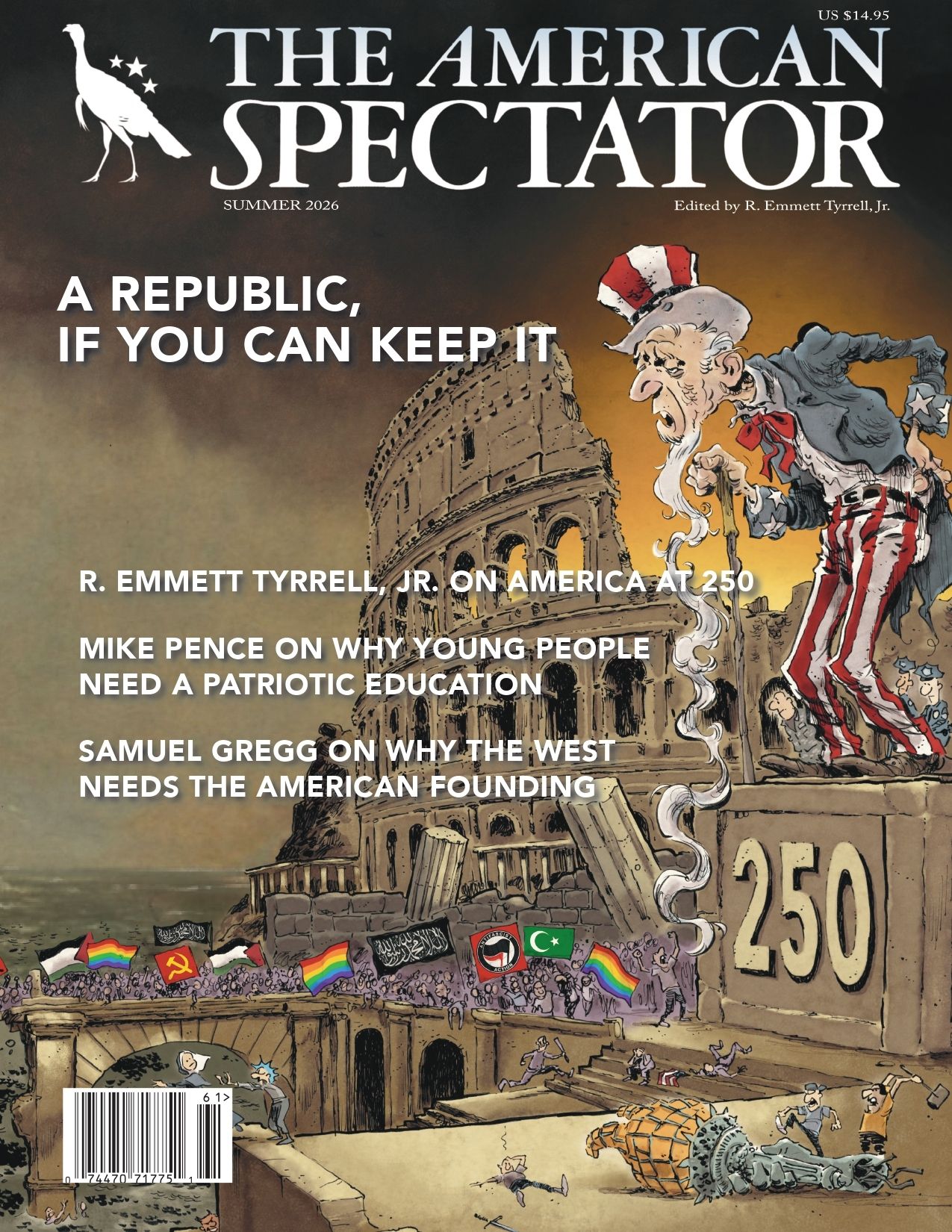
This article is from The American Spectator’s summer 2026 print magazine. Subscribe to The American Spectator to receive the magazine.
Kane had that also in his personal and professional life. His most important scholarship focused on the deeply religious medieval poem Piers Plowman. Since the poet William Langland was an inveterate reviser and amplifier, we have three quite different principal texts, A, B, and C, with many variants, so that to come up with a strong edition the scholar must exercise meticulous care regarding scribal errors, the poet’s intentions, and so forth. But to do that, you must draw on your aesthetic sense and your intellectual insight into the breadth of the poet’s vision, his religious faith, and his artistic and theological order. It requires tact, touch, a virtue nearly forgotten in our current life and in higher education, where it ought to prevail. The opposing vices are celebrated instead: the shrill, the “bold” when boldness is but following along after a noisy fad, the exaggerated, the uncouth, what I call the upside-down pyramid, trying to found an entire reading of a work or an entire interpretation of an artist’s career on some tiny point, often false at that, taken to be all-determining. In the five years I studied under Dr. Kane, I observed this care always in play, born of his reverence for the literature he taught.

Subscribe to The American Spectator to receive our summer 2026 print magazine.
I can imagine myself saying, “Professor, inspired by your neighbor in Saskatchewan, I have memorized Paradise Lost.” Then he would look at me with a crinkled smile, take off his spectacles, wipe them with his handkerchief, and say, with the lilt of a British accent he picked up from teaching in England, “Tony, that is remarkable. And what have you learned by it?”
That is the crucial question. I am not “obsessed” with Paradise Lost, as someone scornfully put it to me. I admire the poem; I think it is the greatest in English; its influence has been immeasurable. “Captain, have you ever read Milton?” the superman Khan asks Captain Kirk in the old Star Trek series. “I understand,” says Kirk. Shortly afterwards, Scotty the engineer says he’s embarrassed to admit it, but he’s not up on his Milton. Kirk explains that it is Satan, saying, “Better to rule in hell than serve in heaven.” The writers got the quote wrong; Satan’s verb is reign, not rule, and the difference, apparently slight, is significant. For Satan, Milton tells us, has desired “to set himself in glory above his peers.” He is an illegitimate monarch, retaining his position by strength of will and intellect, but also by flattery, veiled threats, insinuation, deceit, self-aggrandizement, and secrecy. What Star Trek’s creator, Gene Roddenberry, missed was that when Satan speaks in public, whether in heaven or hell or on earth, he is a liar, a “politician” as that word was understood in Milton’s time, suggesting someone for whom not truth or virtue but policy was the lever of power. I think of the lie Satan tells himself when he first sees the pure and breathtakingly beautiful Adam and Eve, as he tries to excuse the ruin he plans to visit upon them and their Paradise:
And should I at your harmless innocence
Melt, as I do, yet public reason just,
Honor and empire with revenge enlarged
By conquering this new world, compels me now
To do what else though damned I should abhor.
So spake the Fiend, and with necessity,
The tyrant’s plea, excused his devilish deeds.
The romantic view of Satan, which makes hash of the poem, did not begin with Star Trek; it dates at least from William Blake, who wrote in a slyly ironic voice that “Milton was of the Devil’s party, but knew it not.” From then on, Milton’s Satan has been a paradigm of the anti-hero, the rebel against a stifling order — an impossible reading unless you decide that the poem is emotionally and intellectually incoherent, you ignore the drama as Milton has fashioned it, you disregard the faith that animates him at every step, and you refuse to hear the Scripture that Milton’s audience would feel along the pulses of their hearts.
For what has made it possible for me to commit to memory those 10,565 lines of poetry are not the lines taken singly, but the order of the whole, the mutual relations among the parts, the dramatic speeches coherent in effect and authorial intent, the repetition with change that brings before our eyes the same kind of event but in a different form or with different players, and even the local effects that, though small and sometimes nearly invisible, reflect the work in its entirety. I have not memorized lines. I have taken into my heart and mind and aesthetic and dramatic judgment the flesh and bones and limbs and actions of an organic whole.
I trust it will not be controversial to say that poets no longer write with such architectonic care. Even critics of our time seem unaware that anyone has ever done so. But were Milton a slovenly writer, had he permitted himself sentimental digressions, or had he not always observed the rules of grammar and the promptings of rhetoric, I could not have done what I did. I will try to show, then, not only what Kane’s neighbor must have done, but what Kane himself did all through his career: to listen, to balance, to compare, to look at the smallest things with care, and to see how they fit in the whole.
I will give two examples, one small and easy to overlook, one prominent and demanding attention. They are related to one another, and they show, moreover, where we have gone badly wrong, not simply as poets and critics, but as human beings committed to “progress.” When the Son has created Adam, he tells him that he has given him to rule not only Eden but all the earth, and every creature in it,
In sign whereof each bird and beast behold
After their kinds; I bring them to receive
From thee their names, and pay thee fealty
With low subjection.
Note the slight reversal of syntax in the clause I bring them to receive / From thee their names. Not, obviously, the more natural “to receive their names from thee.” Reversals emphasize, and if you have any of the actor in you, as I do, since I commit these speeches to memory by performing them, you will lay a special stress on the pronoun thee, a stress seconded by the pronoun’s repetition in the same line. The force, however slight it may sound in utterance, is in concord with one of the poem’s consistent and most important themes. Man is made in the image of God. He is endowed / With sanctity of reason. He is not low, not “puny,” as Beelzebub scornfully imagines. Indeed, Satan, encased in an enormous serpent, seeks to find Eve alone, since he is afraid of Adam,
Whose higher intellectual more I shun,
And strength, of courage haughty, and of limb
Heroic built, though of terrestrial mould
Foe not informidable, exempt from wound.
But Eve is no simpleton. The queen of the earth cannot be. She too gives things names, and her beauty commands such awe, that Satan himself, as he draws near her, in an astonishing moment, temporarily loses all will, all power:
Such pleasure took the Serpent to behold
This flowery plat, the sweet recess of Eve
Thus early, thus alone; her heavenly form
Angelic, but more soft, and feminine,
Her graceful innocence, her every air
Of action or least gesture overawed
His malice, and with rapine sweet bereaved
His fierceness of the fierce intent it brought:
That space the evil one abstracted stood
From his own evil, and for the time remained
Stupidly good, of enmity disarmed,
Of guile, of hate, of envy, of revenge.
For the fall of man would not be so devastating, had Adam and Eve not been highly exalted. Here, for example, Adam walks forth to greet their divine visitor, the archangel Raphael come to warn them. He approaches
without more train
Accompanied than with his own complete
Perfections; in himself was all his state,
More solemn than the tedious pomp that waits
On princes.
Such is the royalty of the human person, taken singly; a royalty we have strangely forgotten as we subject ourselves more and more to our own machines. But what about Adam and Eve together? Here I turn to one of the poet’s most prominent motifs: the hand. When we first meet the happy couple, they are doing something you rarely see in our gray time:
So hand in hand they passed, the loveliest pair
That ever since in love’s embraces met.
It is not a mere sentimental touch. When they retire for the night, they walk toward their bower hand in hand, and when they arrive, they stand, they turn,
and under open sky adored
The God that made both sky, air, earth, and heaven
Which they beheld, the moon’s resplendent globe
And starry pole: Thou also mad’st the night,
Maker omnipotent, and thou the day,
Which we in our appointed work employed
Have finished happy in our mutual help
And mutual love, the crown of all our bliss
Ordained by thee.
Thus do they pray, hand in hand: and thus is their marital love enfolded by their worship of God who made man and woman each for the other. So did the first man catch the first woman by the hand, wooing her, as Eve pleasantly reminisces:
Thou following cried’st aloud: “Return, fair Eve,
Whom fliest thou? Whom thou fliest, of him thou art,
His flesh, his bone: to give thee being I lent
Out of my side to thee, nearest my heart,
Substantial life, to have thee by my side
Henceforth an individual solace dear;
Part of my soul I seek thee, and thee claim
My other half” — with that, thy gentle hand
Seized mine, I yielded, and from that time see
How beauty is excelled by manly grace,
And wisdom which alone is truly fair.
Each of them before the Fall is awestruck before the beauty and nobility of the other, and their marriage is well signified by their holding hands. But on the dread morning of the temptation, Eve persuades Adam that they might get more work done if they separate their labors, and after some disagreement over the wisdom of doing so, Adam yields, and Eve, promising to return by noon, says she will be on guard. All through their discussion they are holding hands:
So saying, from her husband’s hand her hand
Soft she withdrew.
An ominous moment. Milton’s camera lingers on the hands of a man and a woman together, meant to be joined in the mutual help and mutual love of marriage, the mutuality implicit in their sexual difference.
The Fall, in Milton, is most achingly expressed by alienation. Yes, Milton did argue for liberalization of laws regarding divorce, but he also saw that for us human beings, alienation from God, corrupting or obscuring his image in ourselves, will be found involved with corruption at the heart of marriage. A society of apostates is none at all; man loses hold on himself; affection may preserve marriages in individual cases, but on the whole, we get something like the guilty Adam and Eve before they have confessed their sin. God calls them in the garden from their hiding place:
He came, and with him Eve, more loth, though first
To offend, discountenanced both and discomposed;
Love was not in their looks, either to God
Or to each other, but apparent guilt,
And shame, and perturbation, and despair,
Anger and obstinacy and hate and guile.
What else should we expect? But if we accept the grace of God, we may walk as Adam and Eve do, at the end of the poem, leaving Eden behind, but going forth into an unknown world reconciled to God and to one another:
They hand in hand with wandering steps and slow
Through Eden took their solitary way.
I do not know what my old professor’s religious beliefs were. He was shy of talking about them. That he had a loving and fruitful marriage, I do know. That he would find our world disappointing, I have no doubt. So perhaps I would answer his imagined question thus: “Dr. Kane, I have done it because it brings me some of the tranquility of order.” I think he would approve.
Subscribe to The American Spectator to receive our summer 2026 print magazine.