
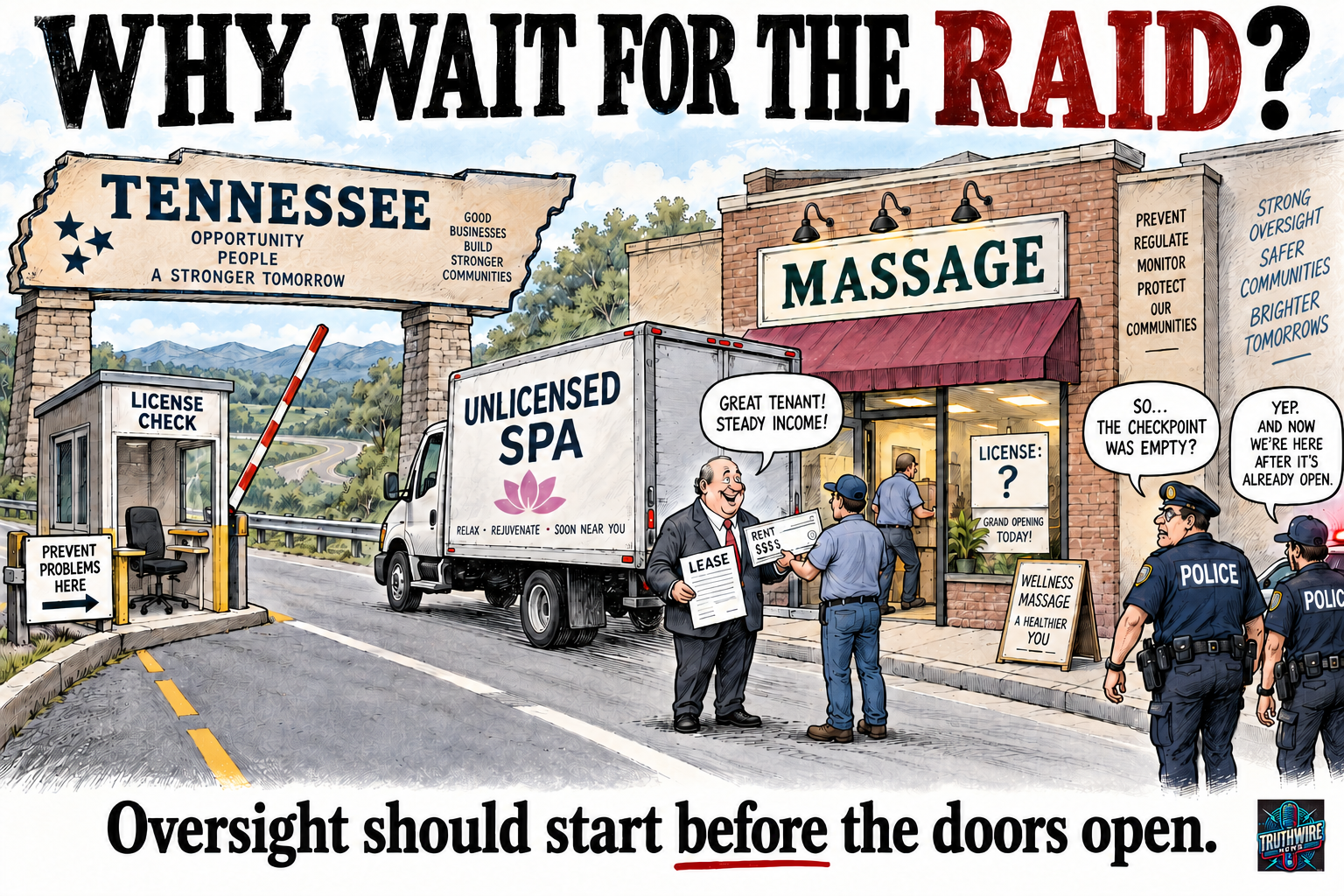
TENNESSEE RAIDED THE SPAS. WHO WAS CHECKING BEFORE THE DOORS OPENED?
- The raid raises questions beyond campaign connections. The public deserves answers about who approved the tenant, verified licensing, and monitored compliance before police arrived.
- TruthWire found no matching license records. A search of Tennessee’s public database returned no matches for the individuals TBI named, raising questions that warrant confirmation with state regulators.
- Tennessee requires massage licenses and applicant background checks. Those requirements apply to the regulated establishment and practitioners, not automatically to a separate building owner.
- A landlord screening requirement remains unestablished. The laws reviewed did not reveal a general statewide mandate requiring commercial landlords to conduct tenant background checks or verify professional licenses before leasing.
- Ending the lease does not answer the oversight questions. State regulators have investigation and inspection authority, while nuisance law can reach property owners. What checks occurred before this raid remains unanswered.
The September 9 raid at a Columbia massage business has produced a political controversy involving both candidates for Tennessee’s 5th Congressional District. It also raises a question that extends beyond either campaign: What safeguards exist before a business opens its doors, and who answers when those safeguards fail?
According to WKRN, Sunshine Spa, also identified as Red Fruit Spa, operated in a shopping center owned by M&CE, LLC. Columbia Mayor and Democratic congressional candidate Chaz Molder holds a 25 percent interest, his campaign said. The campaign stated that he lacked knowledge of the alleged illegal activity and authority to approve tenants, and that the LLC subsequently terminated the lease and evicted the operator.
WKRN also reported that a paid contractor for Republican Charlie Hatcher’s campaign was inside the business during the raid. He resigned afterward, but had not been charged, and his purpose there remained unknown. Those circumstances warrant answers, but the political exchanges should not eclipse the responsibilities of property management and regulators.
TBI’s statewide operation involved six spas and a residence across five cities. Its release identifies Lifang Zeng as charged with prostitution, promoting prostitution, and impersonating a licensed professional; Jin He and Xiaomei Zhao with prostitution, failure to maintain a massage parlor license, and impersonating a licensed professional; and Zenga Xie with promoting prostitution.
Yajing Yang was charged with impersonating a licensed professional. These are statewide arrests, not an identification of everyone arrested at the Columbia property. Although investigators were examining possible trafficking, the release lists no trafficking charge. The allegations remain subject to prosecution and proof. Additionally, the immigration status of all those involved in the raid has not been formally established.
TruthWire searched Tennessee’s public licensing database and found no matching license records for the individuals named in TBI’s release. That result warrants further examination, particularly for those charged with impersonating licensed professionals. It does not resolve historical licensing status or establish which individuals worked at the Columbia location.
Tennessee already requires licensing for massage establishments and practitioners, subject to statutory exemptions. Establishment applicants must submit criminal background checks, and everyone providing massage therapy on the premises must hold the required license. Failure to comply can result in denial or revocation of the establishment’s license.
Those requirements attach to the regulated business and its responsible parties. A separate landlord leasing commercial space does not automatically become the massage establishment’s operator. TruthWire’s review has not identified a general statewide requirement compelling every commercial landlord to conduct criminal background checks or verify a tenant’s professional license before signing a lease.
That distinction matters because a specific penalty for skipping a check requires an applicable legal duty. It also raises a policy question: Should landlords leasing space to regulated businesses be required to obtain and verify the establishment’s license, rather than leave that safeguard to individual business practices?
Oversight of massage licensing belongs to the Tennessee Board of Massage Licensure within the Department of Health. State law empowers the board or its representatives to investigate practitioners and establishments and inspect for licensing compliance. The inspection statute does not specify a recurring inspection schedule.
Advertising or providing massage for compensation without the required valid license is a Class B misdemeanor. The board also has authority to suspend, revoke, or otherwise discipline licenses. Those consequences concern licensing violations; they do not automatically establish liability for a building’s owner.
Property ownership nevertheless is not insulated from every consequence by a lease clause prohibiting illegal activity. Tennessee’s nuisance statute includes premises used for prostitution and expressly reaches owners, agents, and lessees of interests in qualifying nuisances. Court proceedings can seek abatement, providing a remedy separate from enforcing the lease.
The distinction between punishment and prevention deserves attention. Revoking a license addresses a licensed business; identifying one that never obtained authorization requires some means of finding it. How does the state identify those businesses, and how do local business approvals connect with professional licensing checks?
For the Columbia property, the immediate questions are concrete. Who approved the tenant? Was an establishment license requested and verified? Who monitored continued compliance? Were complaints or licensing concerns communicated to management, and what action followed? Molder’s stated lack of approval authority leaves the identity and conduct of the responsible decision-makers unanswered.
The state likewise should explain the establishment’s licensing history, any inspections or complaints, and whether enforcement preceded the raid. Nothing currently presented establishes that regulators ignored a warning, but their oversight history is essential to evaluating whether existing safeguards worked.
Ending a lease after a raid addresses what happens next. Public accountability also requires examining what happened before it, whether anyone checked, who had the authority to act, and whether Tennessee’s rules provide meaningful prevention or primarily consequences after police arrive.
TruthWire exists to provide independent investigative journalism that holds Tennessee's political establishment accountable. We aren't funded by corporations, political parties, or large media companies. We're funded by readers who believe the truth is worth defending.
If this reporting has informed you or helped your community, please consider becoming a monthly supporter.
SUPPORT TRUTHWIRE!