
A Footnote on Christian Philosophy
“There are some people who use philosophy to lead people astray. They lend colour to their errors and paint them over by using a great and acceptable and honourable name” (Confessions 3.8).
This summer I am reading Augustine’s Confessions with two of my sons. I have assigned the book in my philosophy classes at Arizona State University over the years, but this time we are using Henry Chadwick’s translation in the Oxford World’s Classics edition. I mention the edition because it contains a footnote that summarizes one of the most common mistakes in Christian philosophy. When I read it, I thought “there it is, the whole problem of Athens v. Jerusalem in one tiny footnote.”
This Substack is reader-supported. To receive new posts and support my work, consider becoming a free or paid subscriber.
The footnote occurs on page 23 at the end of Book I. Augustine writes, “My sin consisted in this, that I sought pleasure, sublimity, and truth not in God but in his creatures, in myself and other created beings.” Chadwick then comments: “Augustine fuses St Paul (Romans 1) with Plotinus (1.6.8).”
That brief note is worth considering because it captures a familiar assumption. Augustine knew Paul and the Platonists, so he must have fused them. The passage is a good starting point for contrasting pagan philosophy with the Bible’s teaching about clear general revelation. Far from fusing biblical theism with Plotinus’ panentheism or emanationism, Augustine teaches Christians how to study philosophy by beginning with these two truths: all humans are created in the image of God, and all have sinned and come short of the glory of God.
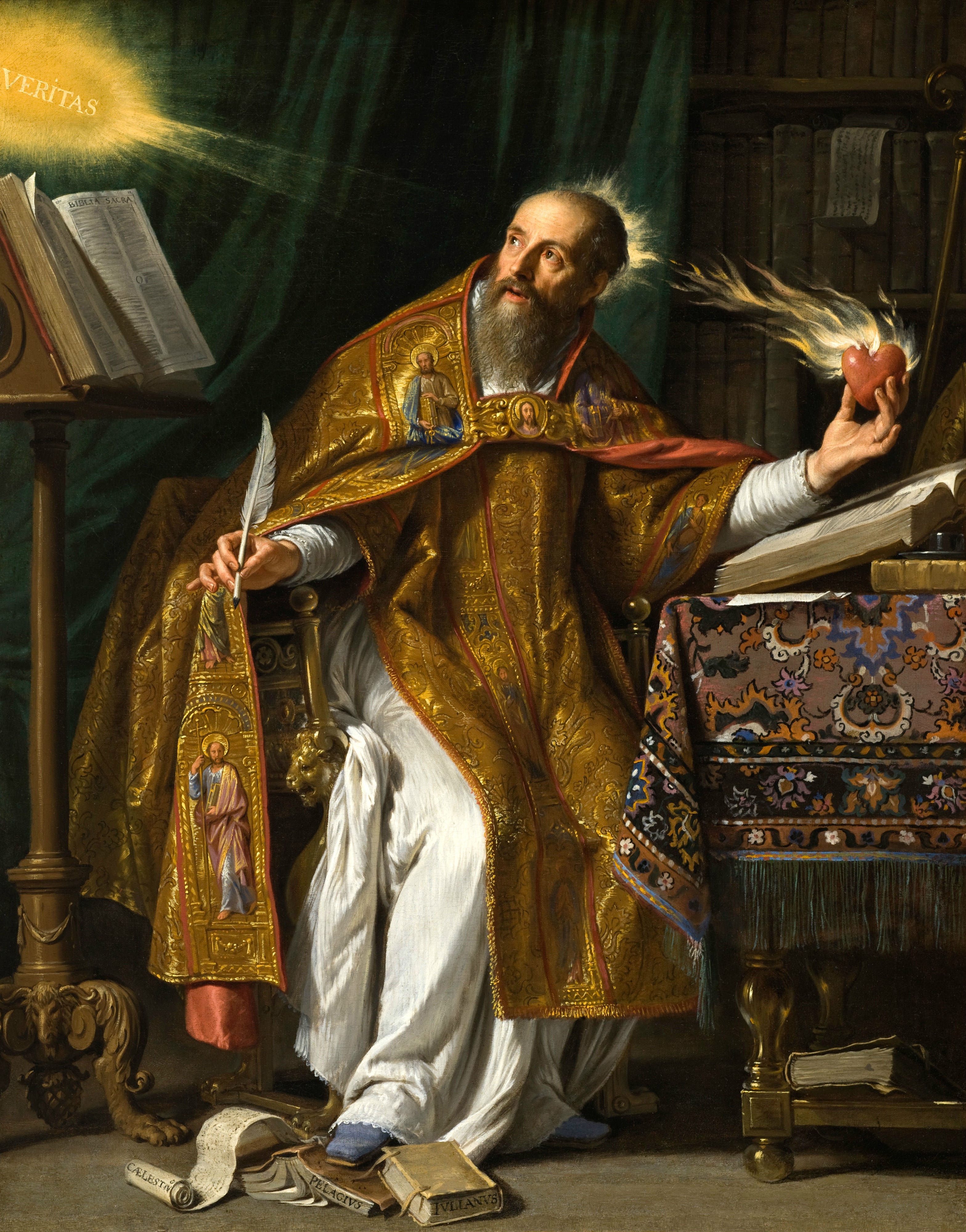
Saint Augustin by Philippe de Champaigne, c. 1645
Part One: Paul and Plotinus
Romans 1 is a long chapter, but Chadwick presumably has in mind verses 18–25:
“For the wrath of God is revealed from heaven against all ungodliness and unrighteousness of men, who suppress the truth in unrighteousness, because what may be known of God is manifest in them, for God has shown it to them. For since the creation of the world His invisible attributes are clearly seen, being understood by the things that are made, even His eternal power and Godhead, so that they are without excuse.”
Paul continues: “Although they knew God, they did not glorify Him as God, nor were thankful, but became futile in their thoughts, and their foolish hearts were darkened.” Professing to be wise, they became fools. They exchanged the glory of the incorruptible God for images of corruptible creatures. Therefore, God gave them up to uncleanness because they “exchanged the truth of God for the lie, and worshiped and served the creature rather than the Creator.” (Rom. 1:18–25)
Notice three things.
First, the works of God reveal God. Creation is revelation. We know God because he reveals himself to us in both general and special revelation. The world is not religiously neutral material from which the philosopher might construct, by autonomous speculation, a possible deity. The world is made by the true and living God and declares the eternal power and divine nature of God. God is eternal (without beginning) and nothing else is; everything else is creation that had a beginning.
Second, this revelation is inferential. God’s eternal power and divine nature are “understood by the things that are made.” The works of God are known as works. Creation does not merely occasion religious feeling; it shows the Creator by what has been made. The creation was originally very good, is now under the curse of God due to sin, and will be redeemed; all three of those stages reveal something about the glory of God. The Christian, of all persons, should be able to demonstrate this. Creation does not merely show us the need for God because created goods don’t satisfy; it reveals to all that it was created by a perfectly wise, powerful, good, just, holy, and loving Creator.
Third, this revelation is clear to all humanity. It is objectively clear, even when it is not subjectively clear to sinners because of darkened minds. The law on a speed limit sign remains clear even if a driver insists that he cannot discern it. When he tells the officer who pulled him over “I can’t read,” he only makes the consequences worse: he is without excuse. Likewise, the problem in Romans 1 is not insufficient revelation. The problem is suppression. There is a clear revelation of God to all humans and yet they worship idols and use them to suppress the truth.
Now consider Plotinus in Enneads 1.6.8. He asks: “But what must we do? How lies the path? How come to vision of the inaccessible Beauty, dwelling as if in consecrated precincts, apart from the common ways where all may see, even the profane?” His answer is withdrawal: “He that has the strength, let him arise and withdraw into himself, foregoing all that is known by the eyes, turning away forever from the material beauty that once made his joy.”
Material beauties, Plotinus says, are “copies, vestiges, shadows.” The soul must not pursue them. It must “hasten away towards That they tell of.” Then comes the famous counsel: “Let us flee then to the beloved Fatherland.” This flight is not geographical. “This is not a journey for the feet.” One must set aside the visible order, “close the eyes,” and awaken “another vision” within.
Plotinus is a panentheist or emanationist who denies creation ex nihilo. He teaches that being emanates from the One, with matter at the lower end. Matter points a person to the One negatively because it is imperfect and limited. Between matter and the One are various levels of spiritual beings, and the human soul must ascend until reaching perfection in a direct vision (non-cognitive, beyond all thought) of the One in the intelligible realm.
The contrast between the biblical theism in Romans 1 and the Neoplatonism of Plotinus is not minor. Biblical theism teaches that the works of God reveal God and that knowledge of God from his works is part of man’s highest good. Pagan Platonism and Neoplatonism teach the soul to turn away from the material world in order to ascend toward higher being. In Paul, man is guilty because he suppresses the revelation of God in creation. In Plotinus, the visible order is something to be left behind in the soul’s ascent. Some pagan philosophers taught that material existence was actually evil, others that it is neutral, others that it is good but not as good as the climb up the chain of being.
Biblical theism teaches that the world was created very good. It reveals God’s glory. The world is now under the curse of God because of sin, and that too reveals the glory of God’s justice and mercy. In redemption, Christians do not escape material existence. They are raised from the dead with physical bodies to dwell in a renewed creation. By contrast, much Platonic and Neoplatonic philosophy taught the soul, perhaps after endless reincarnation, to flee bodily and material attachments in pursuit of a higher intelligible reality.
This also clarifies biblical language about seeing God face to face. Scripture says that God is spirit and that no man has seen or can see him, and also that God spoke to Moses face to face but Moses saw no form. Face-to-face knowledge means intimate friendship and direct divine disclosure (to Moses) rather than knowledge through signs and shadows (to the people of Israel). The Pharisees saw Jesus face to face and it did them no good. Face to face does not mean an immediate supra-rational (non-cognitive) vision of an impersonal highest being beyond thought. Paul and Plotinus are not saying the same thing.
Part Two: Augustine’s Christian Philosophy
“Philosophers have said things that are true, but even them I would think to be no authority for love of you my supremely good Father, beauty of all things beautiful” (3.10).
Augustine gives us a better way than Chadwick ever imagined.
In Book II of the Confessions, Augustine explains that sin is committed when we irrationally give in to an immoderate urge for a lesser good rather than pursuing the highest good. Augustine shows us how the sinner, as one created in the image of God and living in God’s world, is attracted to something real. The world contains truth, beauty, and goodness. The sinner does not simply love his crimes as crimes. He loves something in them that points beyond them. Augustine writes, “No, not even Catiline himself loved his crimes” (2.14).
His own theft of the pears makes the point. Augustine did not steal because he was hungry. He did not steal to feed others. He did not steal because the pears were excellent. In fact, he had better pears available to him. Yet he did steal, and he says that he loved the theft. Still, when he analyzes the sin, he sees that he would not have done it alone. The sin was bound up with companionship. Even this ugly act parasitically attached itself to a created good: friendship. The disorder was not that friendship is evil. The disorder was that Augustine loved fellowship in sin rather than fellowship in God.
This is how Augustine teaches us to study philosophy. When we study pagan philosophers, we can ask: as creatures with minds made in the image of God, what are they noticing? Plato notices that Greek materialists are wrong and that the soul and ideas are immaterial. Aristotle notices that things have natures and that nature is ordered teleologically. Aristotle studies concepts, propositions, and arguments and gives us their anatomy. Philosophers pursue meaning through understanding the world. Since the world is God’s world, they inevitably encounter truths that testify to him. And yet this only deepens their inexcusability for both failing to know God and for promoting a false deity.
The Confessions are full of arguments showing that the material world has not existed from eternity and that the human soul has not existed from eternity. Aristotle taught the eternity of the world. Plato’s Timaeus offers a demiurgic account of cosmic order that later Platonists often read in non-Christian ways. In neither case do we receive the biblical doctrine of creation from nothing by the living God.
For Augustine, the sin of unbelief is not a passive misfortune inflicted on someone by historical circumstances such as having lived in Athens rather than Jerusalem. Humans as sinners are in rebellion against God. The rebellion is expressed in refusing to believe what is clearly revealed in creation. The rebellion is fundamentally irrational: it is grounded in a denial of who God is as Creator and who we are as creatures. Plato and Aristotle are without excuse for the idolatrous deities they promoted and for having suppressed the knowledge of God for millions over centuries.
Philosophy, as the study of general revelation, also points us to our need for redemption. The sin of unbelief cannot be corrected by more lectures and textbooks. After the fall, although general revelation remains clear, the sinful mind is darkened. “For all of this there was a thick mist shutting me off from the brightness of your face, my God” (2.8). For the explanation of how God will redeem sinners, general revelation points us to special revelation (Westminster Confession of Faith 1.1).
Conclusion: A Return to Christian Philosophy
This small footnote in our summer reading launched a discussion with my sons about the deep contrast between pagan philosophy and clear general revelation. That Chadwick thought Augustine, Paul, and Plotinus were teaching the same thing is not merely a mistake. It indicates a significant problem that has plagued Christian philosophy and the Christian academy when it attempts a synthesis with pagan philosophers who deny clear general revelation. Yet Augustine himself provides the solution. And that is what makes this footnote in Augustine’s Confessions both telling and ironic.
Dr Owen Anderson is a philosophy professor at Arizona State University. He is committed to restoring the American University by renewing its pursuit of truth, virtue, and the knowledge of God.
This Substack is reader-supported. To receive new posts and support my work, consider becoming a free or paid subscriber.