
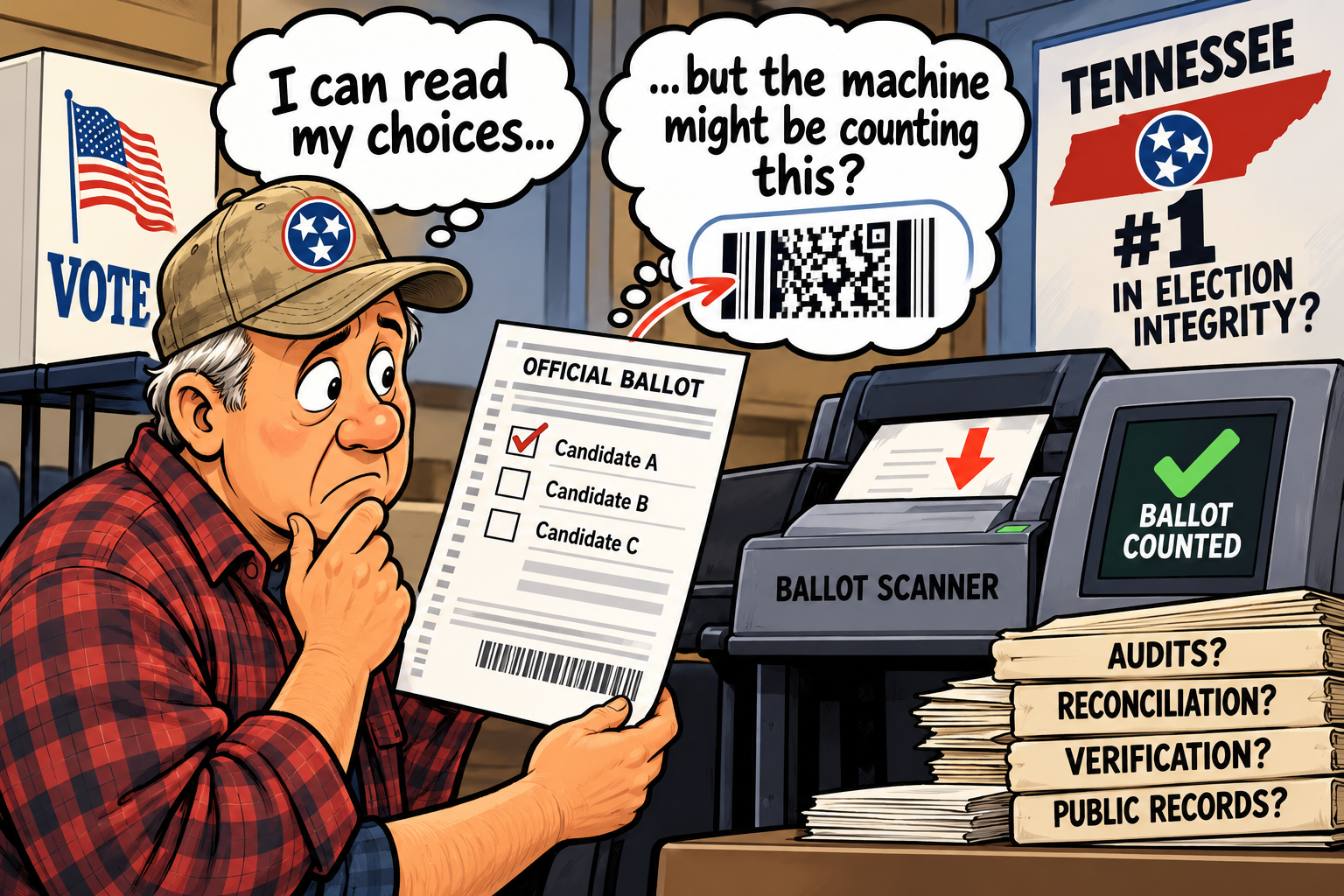
Tennessee Voters Can Read Their Ballots. But Can They Verify What the Machines Count?
Tennessee Election Integrity: Part Two of Three
5 Key Takeaways:
1. A readable ballot isn't necessarily a verifiable ballot. Some voting systems use barcodes or QR codes to tabulate votes, meaning the machine may count information voters cannot read or independently verify.
2. Federal security research has identified vulnerabilities in electronic voting systems. Researchers have demonstrated weaknesses in certain ballot-marking devices, reinforcing the importance of paper records and independent audits. Those findings do not establish that Tennessee's equipment has been compromised.
3. Tennessee lawmakers rejected proposed election safeguards. The Tennessee Voter Confidence Act, which sought to address machine-readable ballot codes and strengthen verification procedures, failed in a Senate committee on March 10, 2026.
4. Williamson County observers reported equipment problems and transparency concerns. A sworn affidavit from the May 2026 primary describes a jammed tabulator, reported override-code issues, and difficulty obtaining voter participation figures needed for ballot reconciliation.
5. Tennessee's No. 1 election integrity ranking doesn't answer the most important question. Certification, testing, and strong election laws matter, but voters should also be able to independently verify that the machines counted their ballots accurately.
When Tennessee voters cast their ballots using electronic ballot-marking devices, they are generally instructed to review the printed ballot before submitting it for counting. The process is intended to give voters an opportunity to confirm that their selections have been recorded correctly. But election integrity advocates have spent years raising a question that goes beyond whether voters can read the printed names on their ballots. Can they independently verify that the machines count those same selections?
In just this past week, reports of ballot marking devices "switching" or not properly recording the vote intended by the voter casting their ballot have been surfacing. The hand marked paper ballots that have been repeatedly requested by voter integrity organizations, would resolve this issue. And yet, those requests seem to continually fall on deaf ears at both the county and state levels.
The general response if there is one, from state and county officials tends to be an argument based on numbers rather than perception. Because there have been so few reports in comparison to the numbers of votes cast, the concern need not be taken seriously.
A reasonable counterargument is that perception often becomes reality in the public consciousness. It takes only a handful of widely circulated reports to plant doubts in the minds of millions, regardless of whether those reports ultimately withstand scrutiny. Since 2020, voters have become increasingly aware of potential vulnerabilities in our election systems, and simply dismissing their concerns does little to restore confidence. Reassurances from election officials, at any level, are no substitute for transparency, independent verification, and demonstrable safeguards that give voters a legitimate reason to trust the process.
The concern involves voting systems that print both human-readable selections and machine-readable barcodes or QR codes. Depending on the equipment and configuration, a scanner may tabulate the information encoded in a barcode rather than interpreting the candidate names and selections printed on the ballot. That means the voter can examine one representation of the vote while the machine may count another. Even when both representations are accurate, the voter has no practical way to independently interpret the encoded information.
The distinction does not establish that votes have been changed or that election results are inaccurate. It does, however, create a verification problem that election security researchers have studied for years. If a voting system produces an electronic record and then relies on machine-generated information to count that record, an independent audit becomes particularly important. The audit must be capable of confirming that the electronic count matches the choices voters could actually see.
Williamson County uses Election Systems & Software equipment, including ExpressVote ballot-marking devices and DS200 scanners. The county's election information page describes its voting procedures and provides information for voters. The precise configuration of the equipment matters because the presence of a barcode does not, by itself, establish exactly how a particular scanner interprets the ballot. That is a question county officials should be able to document for voters who want to understand how their choices are counted.
Research involving other voting systems illustrates why the issue has attracted attention. University of Michigan election security researcher J. Alex Halderman has examined vulnerabilities affecting Georgia's Dominion ImageCast X ballot-marking devices, including the possibility of manipulating information associated with machine-readable ballot records. Those findings concern a different manufacturer's equipment and do not establish that Tennessee's systems have been compromised. They demonstrate why researchers emphasize the importance of a voter-verifiable paper record and an independent method of checking the electronic count.
A July 2026 federal election security report also discussed vulnerabilities identified through assessments of election technology, including software maintenance, delayed security updates, and cybersecurity weaknesses. The report reinforced the importance of human-readable paper records, meaningful audits, and improved security practices. Such findings are not evidence of election manipulation in Tennessee, but they provide context for proposals intended to reduce dependence on electronic systems that ordinary voters cannot independently examine.
Tennessee election integrity advocates have argued that hand-marked paper ballots offer a more straightforward method of verification. Under that approach, voters make their selections directly on paper, and optical scanners count the marks. The paper ballots can then be manually examined to determine whether the electronic tally accurately reflects the votes. This method does not eliminate human error, improper ballot handling, or every possible security concern, but it provides a record created by the voter rather than by the ballot-marking software.
The Tennessee Voter Confidence Act, introduced as Senate Bill 1028 and House Bill 999, sought to address these concerns through changes to election technology and verification procedures. The proposal included restrictions involving barcode or QR-code-based vote tabulation and measures intended to strengthen independent review of election results. Supporters viewed it as an opportunity to establish greater confidence that the choices visible to voters would determine the official count.
The legislation failed in the Senate State and Local Government Committee on March 10, 2026. Its failure left the existing voting framework in place and added to the frustration of advocates who had pressed Republican lawmakers to address the issue. Tennessee's national election integrity ranking continued to be promoted, but the proposed changes intended to make vote tabulation more independently verifiable did not become law.
The debate is not limited to the technology used to mark ballots. It also involves what happens when voting equipment malfunctions and whether election observers can obtain the records needed to understand how problems were resolved. Those questions became particularly relevant in Williamson County following the May 5, 2026, primary election.
In a sworn affidavit dated May 12, election observer Frank Limpus described problems he witnessed while monitoring closing procedures at Academy Park Gym in Franklin. Limpus, who leads Tennessee Voters for Election Integrity, reported that a ballot became stuck in a tabulator shortly before the polls closed. According to his account, election workers contacted the election office and followed instructions to access the equipment and remove the ballot before reassembling the machine.
Limpus stated that workers subsequently directed voters to use the other tabulator because they did not want the problem to recur. He reported closing counts of 262 ballots for one tabulator and 254 for the other, figures he included while describing the equipment incident. His affidavit does not establish that either count was incorrect, but it documents a situation in which election workers had to intervene in the operation of a tabulator during voting.
The observer also described information he received from other Williamson County polling locations. According to the affidavit, observers at Pearre Creek and Fairview reported problems involving equipment that required override codes during closing procedures. Limpus said he observed a similar issue at Academy Park Gym and questioned why some equipment appeared to require additional intervention to complete the closing process.
Those observations do not demonstrate that anyone altered votes or improperly accessed election results. Election equipment can require troubleshooting for legitimate reasons, and poll workers need procedures for addressing malfunctions. Nevertheless, incident reports, equipment logs, and other records should provide an explanation of what occurred, who authorized corrective action, and whether the problem affected ballot accounting.
Limpus also reported difficulty obtaining the day's voter registration or participation count from election workers. He wanted to compare the number of voters who had checked in with the number of ballots recorded by the tabulators. According to his affidavit, he had informed a poll official that he wanted the figure before the registration equipment was shut down, but he did not receive it.
That concern goes directly to ballot reconciliation. If the number of voters who participated can be compared with the number of ballots accepted for counting, officials have a basic method of identifying discrepancies. A mismatch does not necessarily mean misconduct occurred, because spoiled ballots, provisional ballots, equipment issues, and administrative procedures can affect the accounting. But those differences should be documented and explained rather than left unresolved.
Limpus's affidavit is a firsthand account of some observations and a report of information he received from others. It should not be treated as a final determination that Williamson County violated election procedures or produced an inaccurate result. Its significance is that it identifies specific incidents and records that can be examined to determine whether established procedures were followed.
The distinction between ballot reconciliation and a manual audit is important. Reconciliation examines whether the number of ballots is consistent with the number of voters and the records of ballot handling. A manual audit examines whether the votes recorded on the paper ballots agree with the electronic tally. A county may complete reconciliation without independently verifying the accuracy of every electronic count, and a limited audit may test tabulation accuracy without resolving every ballot-accounting question.
In their Comprehensive Voting Model Recommendations, Williamson County advocates proposed going further than the failed state legislation. Their recommendations included removing routine reliance on ballot-marking devices, using high-security hand-marked paper ballots, conducting more extensive equipment testing, documenting voter participation against tabulator counts, and manually checking electronic results. They also proposed making election reports available for public examination and eventually eliminating electronic tabulators altogether.
Some of those recommendations would require substantial operational changes. Replacing equipment, expanding manual counting, modifying early voting procedures, and returning to more neighborhood precincts would involve staffing, costs, accessibility requirements, and election administration planning. Those practical considerations deserve examination, particularly because any replacement system must continue to accommodate voters with disabilities and protect ballot secrecy.
The advocates' broader argument is that Tennessee should evaluate whether its current system offers enough independent verification. A machine can be certified, tested, and operated according to established procedures while still requiring post-election checks capable of detecting errors. Certification demonstrates that equipment met specified requirements under defined conditions; an audit provides evidence about what happened when that equipment was used in an actual election.
Transparency is another part of that equation. Publicly available procedures, incident reports, reconciliation records, and audit findings can help voters understand whether election officials detected discrepancies and how they resolved them. Those records can also help distinguish ordinary technical problems from more serious concerns, reducing speculation by replacing unanswered questions with documented explanations.
The central question for Tennessee is not whether all electronic voting equipment should automatically be considered unreliable. It is whether the state has established sufficient safeguards to verify that electronic tabulation accurately reflects the choices recorded on voter-verifiable paper ballots. The strongest answer would be an independent process that can identify discrepancies and demonstrate the accuracy of reported results.
Tennessee's lawmakers have already been presented with proposals addressing that question, and federal election security recommendations have reinforced the importance of paper records and manual audits. Whether the state chooses to adopt those proposals remains a legislative and administrative decision.
What voters are asking is straightforward: Did the machine count what I actually voted for, and can anyone independently prove it?
TruthWire exists to provide independent investigative journalism that holds Tennessee's political establishment accountable.
We aren't funded by corporations, political parties, or large media companies.
We're funded by readers who believe the truth is worth defending.
SUPPORT TRUTHWIRE!